Modeling overview
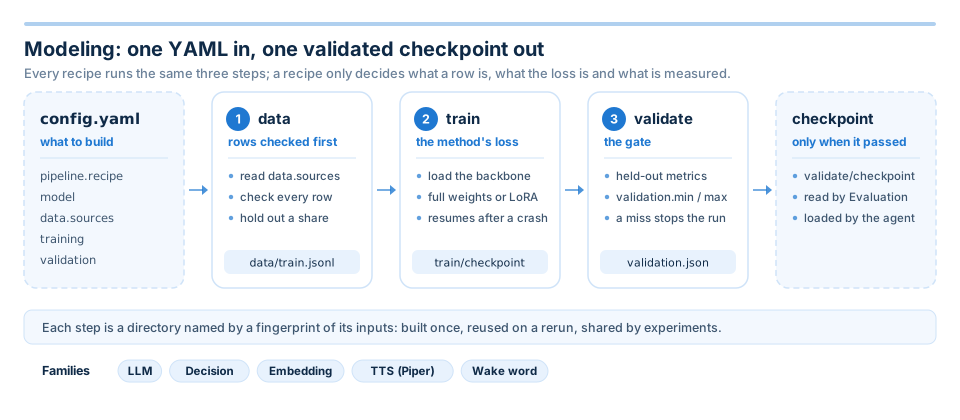
The Modeling channel turns one YAML into one trained model that has passed a validation gate. It covers five kinds of model, from a chat model to the detector that wakes a voice agent, and every one of them is built the same way: read and check the rows, train, validate on rows training never saw. Only a model that passes is handed on.
What it builds
| Kind of model | Recipe (pipeline.recipe) | Learns from | Base models (model.architecture) | Result |
|---|---|---|---|---|
| Chat and instruction LLM | llm_sft, llm_instruction | conversations; instruction, input, output records | transformer (Qwen3-0.6B, 1.7B), hybrid (Qwen3.5-0.8B, 2B) | a save_pretrained checkpoint |
| Preference-tuned LLM | llm_dpo | a better and a worse answer to the same prompt | same | same |
| Reward-tuned LLM | llm_grpo | prompts with a checkable answer | same | same |
| Decision model | llm_decision_sft, llm_decision_cispo | a state and typed questions about it | same, plus a head: readout or pointer | the checkpoint with a calibrated head |
| Embedding model | embedding_contrastive | query, positive and optional negative texts | bi_encoder (Qwen3-Embedding-0.6B) | the checkpoint, pooling included |
| Voice (TTS) | tts_piper | recordings and their texts | a Piper (VITS) checkpoint, medium or high | voice.onnx and fixed replies as WAV |
| Wake word detector | wakeword | recordings of the name and of everything else | openWakeWord's frozen features with a small head | <phrase>.onnx for openWakeWord |
Pick a recipe by the data you have
- Conversations (
messageswith user and assistant turns):llm_sft. - Instruction, input, output records:
llm_instruction. - Pairs of a better and a worse answer:
llm_dpo. - Prompts with a checkable answer (a number, an exact string, a rule):
llm_grpo. - A state and a question with fixed options (route, classify, rate):
llm_decision_sft, thenllm_decision_cispoif reasoning before the decision should help. - Query and document pairs for retrieval:
embedding_contrastive. - Recordings of a voice:
tts_piper. Recordings of a name:wakeword.
No rows yet? The Data channel makes them, in the format each recipe reads.
What every recipe shares
- One YAML, one experiment.
pipeline.recipepicks the recipe, the other sections say what to build. The experiment directory isoutput/<name>-<hash>/; the same YAML run twice builds nothing the second time. - The validation gate.
validatefollowstrainand cannot be left out.validation.minandvalidation.maxname the recipe's metrics; a miss stops the run, and<experiment>/validate/checkpointexists only for a model that passed. Later recipes (evaluation, a second training stage throughmodel.init) read that link. - Checks before spending compute. Every row is checked against the recipe's format and measured against
training.max_lengthbefore the first step, so a bad row stops the run at the start, not hours in. - Resume after a crash. Training keeps a snapshot and continues from it with the same batches and the same random draws, so an interrupted run ends with the weights an uninterrupted one would have.
The pages below go one level down: a family's page explains what its recipes share, and each recipe's page shows its row format, the YAML the repository ships, and how to run it.
Source: handwritten. This page is generated; edit the source and run npm run sync.