Evaluation overview
Training tells you the loss went down. Evaluation tells you whether the model got better at what you care about, and whether that number can be trusted. The Evaluation channel measures any checkpoint Modeling built, or a base model from the Hub, on items it never trained on, and reports how much of the evaluation set leaked into training next to every score.
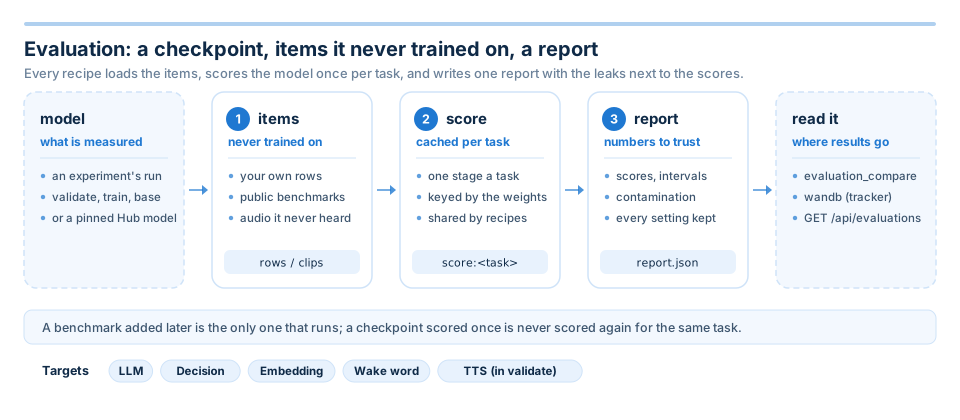
What it measures, by kind of model
| Model | Recipe | Measured on | Headline numbers |
|---|---|---|---|
| LLM, decision or embedding model | evaluation_custom | your rows, in the format the model trained on | the training recipe's own validation metrics |
| Generative LLM | evaluation_benchmark | public benchmarks through lm-evaluation-harness (English and Korean presets) | accuracy or exact match per benchmark, with its standard error |
| Several checkpoints and the base | evaluation_compare | the same benchmarks, rows, decision questions or MTEB tasks for every run | the difference to the base with a verdict, a polygon chart |
| Decision model | evaluation_decision | Jev rows or the JevBench tiers, without and with reasoning | accuracy, NLL, ECE, latency |
| Embedding model | evaluation_embedding | MTEB tasks | each task's main score |
| Wake word detector | evaluation_wakeword | voices and hours of audio it never heard, clean and in noise | miss rate, false accepts per hour, the threshold sweep |
| TTS voice | tts_piper's own validate | held-out texts read by the voice, transcribed by Whisper | wer against the recordings' reference_wer |
Which one to run
- Right after training:
evaluation_customon rows you care about, withcheckpoint: baseonce for the baseline. - Before trusting a fine-tune:
evaluation_compareof the base and the trained checkpoint on a benchmark preset, so a gain on your task and a loss in general knowledge show up together. - For decision, embedding and wake word models: their own recipe, because their metrics differ (calibration and latency; retrieval scores; false accepts per hour).
Everything is a recipe on the same runner as training: a score is cached per checkpoint content, task and settings,
so comparing three checkpoints scores each benchmark once per checkpoint, and a benchmark added later is the only one
that runs. Reports land in report.json, go to wandb with tracker.enabled, and are listed by the API.
Score trained models beyond the validation gate: on public benchmarks, on custom evaluation sets, and across several checkpoints at once, with a report a person can read. The question it answers is "which checkpoint of this model is best, on what, and compared with the base model".
| Rows | Checkpoints | Decides | Where | |
|---|---|---|---|---|
training.eval_every | the experiment's own held-out rows | the weights at that step | nothing; a curve next to the loss | training.jsonl, tracker |
validate | the experiment's own held-out rows | the one it trained | pass or fail against validation.min / max | validation.json |
| Evaluation channel | any benchmark or evaluation set | any number, plus the base model | nothing; results kept for comparison | output/<evaluation>/report.json, a chart |
Source: evaluation/README.md. This page is generated; edit the source and run npm run sync.